
Enterprise Wireless Network Deployment in Bahrain
How MTT — My Telecom Technology — approached the design, installation and commissioning of an enterprise wireless network across indoor and outdoor areas of a working site in Bahrain.
Client identity, site location, network addressing, layouts and configuration details are withheld. This profile describes the engineering approach in qualitative terms only; no performance figures or system quantities are published.
- Location
- Bahrain
- Sector
- Commercial and industrial operations
- Project category
- Wireless networks and network infrastructure
- Client
- Identity withheld
Client profile
The client is an organisation in Bahrain operating a working site that combines office accommodation with operational areas and external space. Staff, contractors and visitors all use the site, and several day-to-day activities depend on wireless connectivity rather than fixed desks.
The client is not named, and no facility imagery, drawing or network detail that could identify the organisation is published here.
The challenge
Wireless connectivity had grown over time rather than being designed as a system. The practical symptoms reported were familiar ones:
- coverage that was strong in some areas and unusable in others;
- connections that dropped when users moved between areas rather than handing over cleanly;
- noticeable slow-down when many devices were active at the same time;
- limited coverage in outdoor and peripheral areas where work actually took place;
- little visibility of what was installed, how it was configured, or where faults originated.
The objective was a wireless environment that behaved consistently across the site and could be supported and extended in a controlled way.
Site assessment
MTT began with a survey rather than a product proposal. The assessment covered:
- the areas that needed coverage and the activities carried out in each;
- building construction, internal layout and materials affecting signal propagation;
- measured signal levels and interference from existing and neighbouring systems;
- the condition and capacity of existing cabling and switching;
- power availability and protection in communications rooms;
- mounting options, containment routes and environmental exposure outdoors.
The survey findings, rather than assumptions, defined where equipment was needed and what the wired network had to support.
Engineering approach
The design treated wireless as the visible layer of a wired system. Work was sequenced so that the infrastructure underneath was corrected before radio coverage was extended.
- Step 01Define requirements
Coverage areas, device types, applications and growth expectations were agreed in writing with the client.
- Step 02Design coverage
Access-point positions, antenna selection, channel plan and transmit-power settings were designed from survey data.
- Step 03Size the wired layer
Switching capacity, power over Ethernet provision, uplinks and cabling were specified to support the wireless design.
- Step 04Plan segmentation
Separate networks were defined for corporate users, guests and operational devices, with policy applied between them.
- Step 05Stage the works
Installation was sequenced to limit disruption to daily operations on a live site.
- Step 06Verify and document
Coverage and roaming were validated after installation and the delivered system was documented for handover.
Architecture and technologies
The delivered architecture combined indoor and outdoor wireless coverage with a managed wired backbone. Described in general terms, it comprised:
- centrally managed enterprise access points serving indoor areas, with positions and antenna patterns chosen per area;
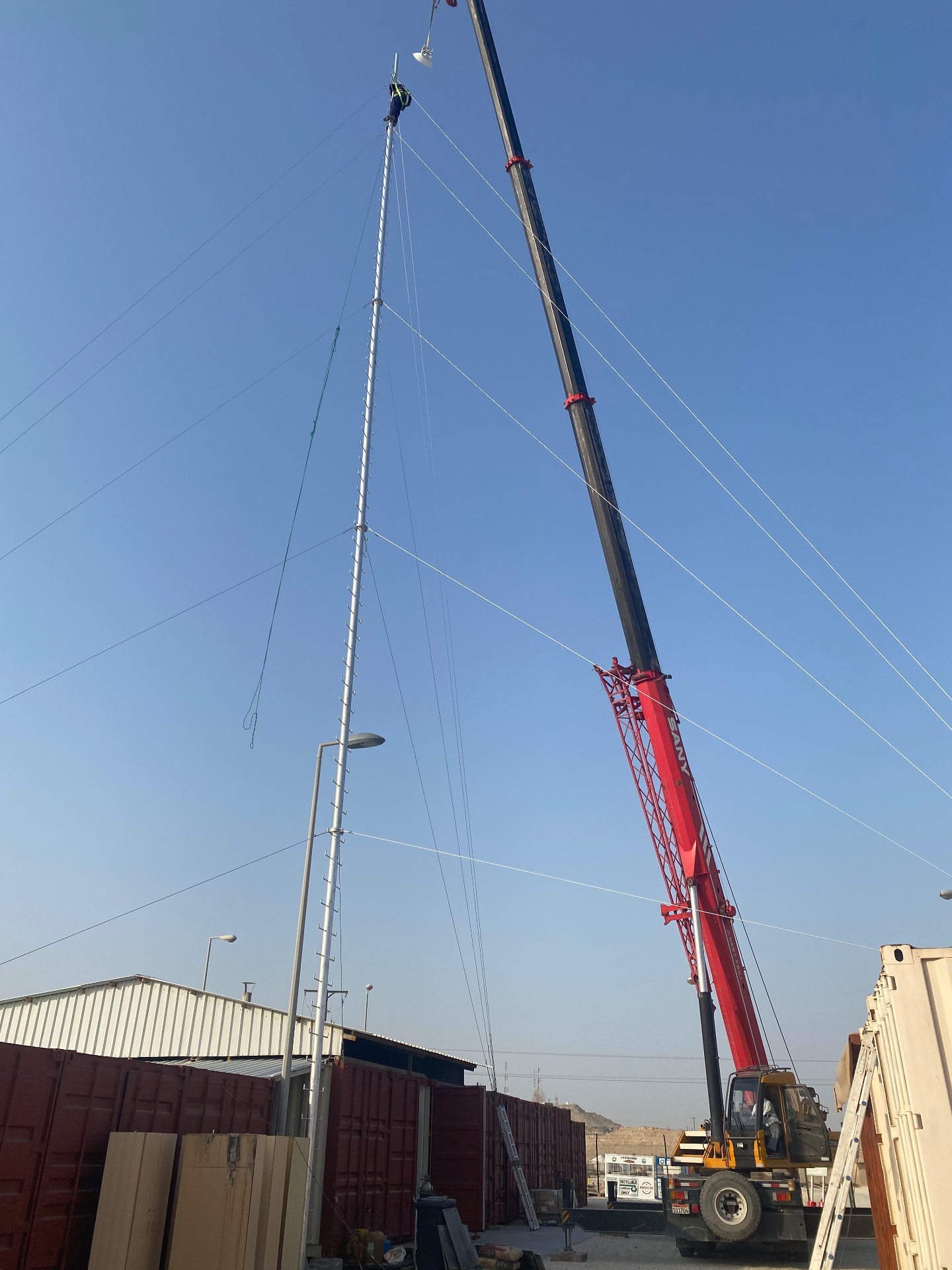
- weather-rated outdoor access points with appropriate mounting, surge protection and earthing for external coverage;
- wireless transport where cabling between locations was impractical, engineered for line of sight and required capacity;
- access switching with sufficient Power over Ethernet capacity and resilient uplinks;
- structured copper and fibre infrastructure tested and documented as part of the works;
- segmented networks with firewall policy separating guest traffic from internal systems;
- a central management platform providing configuration control, firmware management and monitoring;
- power protection for network rooms so equipment rides through short interruptions.
Specific vendors, models, quantities, addressing and configuration parameters are deliberately not published.
Installation and commissioning
Installation was carried out on a live site, so the works were staged area by area with agreed working windows. Cabling and containment were installed first, followed by mounting and termination, then equipment installation and configuration.
Commissioning included:
- testing and recording results for the installed cabling links;
- configuring network segments, wireless profiles, security policy and traffic prioritisation;
- validating coverage and roaming behaviour by walking the site after installation;
- adjusting channel and power settings where measurements showed overlap or interference;
- confirming management-platform visibility, alerting and configuration backups;
- handover documentation, labelling records and a client walkthrough of the delivered system.
Outcomes
The outcomes below are described qualitatively. No measured performance figures are published, because the client's operational data is not shared publicly.
- Coverage designed and verified across the agreed indoor and outdoor areas
- Roaming behaviour addressed through overlap, channel and power planning
- Wired capacity and power over Ethernet aligned to the wireless design
- Guest and operational traffic separated from internal systems by policy
- Central visibility of devices, configuration and firmware status
- Documented cabling test results and as-built records at handover
- A defined route for future expansion without redesigning the network
Maintenance and support
After handover the system is supported through a maintenance arrangement covering monitoring of device availability and network health, controlled firmware and configuration management, periodic review of coverage as the site changes, fault response, and updates to documentation whenever changes are made.
This keeps the delivered design accurate over time rather than drifting as ad-hoc additions accumulate.
Related MTT capabilities
Discuss a Similar Project
If your site has coverage, capacity or roaming problems, an MTT engineer can review it with you and propose a structured approach. Requests are handled through our protected enquiry form.